
Current Issue Analysis: Media Violence
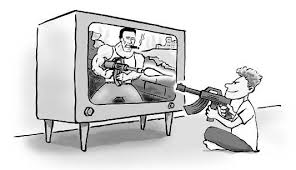
Violence throughout media has long been a contested topic in our media driven society. Violence in media can manifest itself in multiple forms, whether it be physical violence in movies and games, verbal violence in sitcoms or cartoons, or even emotional violence through what someone posts on social media. These varying forms of violence often come under scrutiny because they can leave a negative affect on an audience, which is why media creators try to “sanitize” violence to make it more acceptable in the audience’s eye. However, even with the sanitation, the violence can still have an effect on children.
Physical violence can be found across all media. We can see acts of physical violence in movies about war, in first person shooter games, and in animated cartoon shows. The violence depicted doesn’t necessarily have to be against other humans, as we discussed in lecture. It can be against animals, monsters, aliens, etcetera. Often times when there is a show of physical violence in media, it is to enhance a story and recreate real scenes. For example, you can’t make a war movie without the destruction and death that come with war. While these films and games need to include violence to increase their authenticity, the gore and roughness shown can have a serious affect on the audience. According to an article from the American Psychological Association, children who consistently watch violence on TV may experience three different effects. Children may be desensitized to pain and suffering, they may have more fear of the outside world, and they may be more likely to behave aggressively towards others. A lot of people say that they are unaffected by the physical violence seen in media, however these effects can impact anyone.
This YouTube video shows five of the goriest and brutal movies scenes ever.
Violence in media is not just limited to blood and death. Verbal violence and insults can have just as large an impact as physical violence. We see verbal violence all the time in media, and again it can have a lasting effect on an audience. It seems like in just about every form of media, there is some form of verbal violence. People watch TV and see characters go back and forth insulting each other, creating this idea that is okay to verbally attack people without repercussions. While everyone knows the saying “sticks and stones may break my bones, but words can never hurt me,” it is often times what people say that can cause the deepest harm. Just this past week, an Olympic level gymnastics coach was levied an eight year ban for verbally and emotionally abusing her athletes. The idea of verbal violence and abuse is everywhere and society, and its portrayal in media only adds fuel to the fire.

Both verbal and emotional violence play a huge role in the perceived negative aspects of social media. Cyber bullying is the main cause for verbal and emotionally abuse through social media, largely because people are able to hide behind their keyboard and screen, sending out hateful and incredulous messages without any real threat of consequences. According to an article from Pew Research, almost three in five students have experienced some form of cyber bullying. The verbal and emotional violence they experience just by opening their phone can have can extremely negative effects to their mental health. As we discussed in our last discussion board, social media can crush a teens mental health, and the verbal and emotional violence they can experience from cyber bullying only adds to that effect.
While all these different forms of violence exist in media, they are not always presented in their most real form. Changing certain aspects of the violence to lessen the influence is something we discussed in lecture, and it is referred to as “sanitizing” the media. With regards to physical violence, media can be sanitized in numerous ways. For example, blood and gore may be significantly reduced. In some shows, we still see the violence (such as someone being shot and killed), but there is no blood shown. If an injury is not fatal, the health effects of the injury are only temporary. Additionally, physical violence can be sanitized by simply not showing it on screen. It still happens, but the audience is shielded from the brutality. When looking at emotional and verbal violence, it is often sanitized with humor. The verbal abuse is followed by a funny joke or ironic statement which reduces the impact of what was previously stated.

Personally, I believe violence in media is an important way to maintain the authenticity of what is being created. In every day life, we experience some form of violence on a pretty regular basis. To avoid or limit the amount of violence shown in media means that the media no longer paints an accurate picture of what life is like. When it comes to media that is viewed by children however, I believe that the violence should be sanitized to a certain degree. We do not want to expose children to certain images and situations that they cannot yet comprehend, so we must sanitize violence to a point where it shields the children while still holding that level of authenticity previously mentioned.
To conclude, media violence is something that can be observed across almost all forms of media. Violence is a natural part of human life, so including it in media is a strive to maintain an accurate portrayal of the life we live. While the violence is natural, it still can cause negative psychological impact in an audience, especially children. Finding the right balance between the showing and sanitizing of violence is the key to producing successful media.
Media Cultures: Video Games

For as long as I can remember I have been an avid sports fan. I grew up watching Eagles and Sixers games with my dad, and I have carried that heavy interest in sports with me my entire life. One media culture I never really found myself a part of would be the video gaming community. While I have of course played different games over my life, Ive never owned a gaming console and have always wondered why video games engross such a large demographic of people. Through this post, I will talk about the appeal of video games and how they provide valuable ideals to people of all ages.
The video game culture uses doesn’t just use media, it is media. Games are developed first and foremost to provide entertainment, but some games also provide valuable lessons that can be expanded upon in real life. For example, let’s take the game Animal Crossing. Animal crossing is a game where you live as a little animated animal in a small town. Through the game, you can do chores for neighbors, fish, garden, and pretty much just live. The game provides a sense community and inspires joy through helping neighbors and others in need. While not all games provide these uplifting themes, there are many that do and it can leave a lasting impact of the community as a whole.

Video games also can hold multiple different roles in a person’s life. One of the front-running reasons is that the games are just fun, and serve as a form of entertainment. Others can see games as a way to unwind from a stressful day. Video games can also help develop cognitive and learning skills. This article from the American Psychological Association talks about the learning, health, and social benefits that video gaming can have to children. This youtube video also attests to the cognitive and memory skills that gaming can enhance. Additionally, video gaming can offer people a sense of competition, just like in sports. In just about every game, there is some level of competition, whether it’s against other players or versus the game itself.
In our lecture videos, we talked about the different needs that play into a media culture. One of these needs that is satisfied by the video gaming culture would be the social need. One would think sitting in front of a screen playing games doesn’t allow for socialism, but it is quite the opposite. Games can be played online, meaning that you are able to play with, connect with, and socialize with anyone around the world. Friends log on to games and play with each other all the time, but there are even instances where people become friends playing together that have never actually met in real life. This article from BBC talks about a group of friends that had never met in real life, but had formed an incredible friendship. When one of the friends fell terminally ill, the whole group flew out to his hospital bed, which was the first time any of them had met in real life.
Overall, video game culture is quite impactful in many people’s lives. I was never really aware of the effect video games have, and the benefit it can bring to so many different people. This post opened my eyes, and I think this culture is now something I want to be a part of.
Reality Depictions: The Bachelor

There are many different entertainment platforms and TV shows that attempt to portray reality. One such show that does this is The Bachelor, a dating show on ABC that has a bunch of girls who are all trying to win the heart of one “bachelor” and find love. The show is very popular, drawing 6.1 million viewers for this past season’s premier, according to The Hollywood Reporter. Despite its popularity, I feel The Bachelor fails at portraying accurate reality.
One aspect of reality in media is through factuality, which asks whether or not the media portrays accurate people and situations. A situation in which a guy dates twenty different girls and picks the one he likes the most is not a realistic part of society, so in this aspect The Bachelor fails to portray reality. Another aspect that The Bachelor fails at accurately portraying is social utility, or the idea of having messages in the media that can be used in every day life. A dating show does not really support any messages that you can use in everyday life. An aspect of reality in media that The Bachelor accurately portrays is identity and emotional involvement. The show does portray real people and shows their real emotions.
In conclusion, The Bachelor is a show that depicts real people and emotions, but not a real situation that may happen in life. A dating show where twenty girls compete for one guy is just unrealistic, and that is why the show fails at accurate showing reality.
Disney’s Purchase of 21st Century Fox
Disney recently completed a purchase of the majority of 21st Century Fox’s movie and television assets for 71.3 billion dollars. This deal gives Disney complete control over franchises like The X-Men, The Fantastic Four, the Simpsons, and many other popular series and movies. The deal gives Disney the rights to some fox television networks like FX and National Geographic. Additionally, Disney received Fox’s thirty percent stake in the streaming service Hulu, so they are now majority owners with a stake of sixty percent.
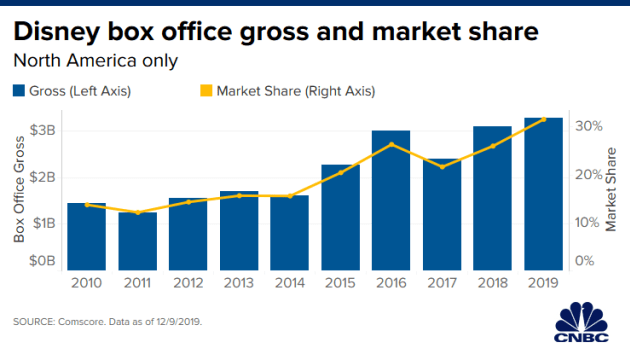
Disney has made many previous acquisitions before this as well. They have purchased ABC, ESPN, Marvel, and Lucasfilm to name a few. As Disney gains control of more and more media, we have to worry about something called media consolidation, which was talked about in an article on Vox that we read for our week 5 readings. Media consolidation is essentially having giant corporations own more and more of our media, so that eventually the whole media industry gets monopolized by a few dominant companies. Disney’s purchase of 21st Century Fox is a step closer to media consolidation, which is why I think the purchase will cause harm to the media landscape.
Disney’s continued expansion across the entertainment platform means that they’re in control of a large part of the market, especially in the streaming service. An article written on CNBC goes in depth about the success of Disney+ and how Disney wants to expand and take over the streaming market. The fact that Disney already controls so much of the streaming media is a negative in my opinion, because they now have the ability to control prices and the messages that movies and TV shows demonstrate.

In the lecture videos, we spoke about the Telecommunications act of 1996, and how it overhauled media laws and let media companies grow very large. This change in law back in 1996 was the start of Disney’s expansion in the media landscape, as the change in law allowed Disney to purchase ABC.
Media Log
Wednesday, February 12, 2020
- Feb 12, 8:30 am, cell phone, check social media, snapchat, texts, etc., 15 min
- Feb 12, 10 am, cell phone, check social media, snapchat, texts, 30 min
- Feb 12, 1:30 pm, cell phone, check social media, snapchat, texts, 15 min
- Feb 12, 4 pm, cell phone, check social media, snapchat, texts, 15 min
- Feb 12, 4:30 pm, xbox, play madden, 2hours
- Feb 12, 6:30 pm, cell phone, check social media, snapchat, texts, 15 min
- Feb 12, 8:30 pm, laptop, homework, 60 min
- Feb 12, 10 pm, cell phone, check social media, snapchat, texts, 15 min
285 minutes total
Thursday, February 13, 2020
- Feb 13, 9 am, cell phone, check social media, snapchat, texts, 15 min
- Feb 13, 12 pm, cell phone, check social media, snapchat, texts, 15 min
- Feb 13, 3:30 pm, cell phone, check social media, snapchat, texts, 15 min
- Feb 13, 6 pm, cell phone, check social media, snapchat, texts, 15 min
- Feb 13, 7:30 pm, xbox, nba2k, 60 min
- Feb 13, 8:30 pm, laptop, homework, 60 min
- Feb 13, 10 pm, cell phone, check social media, snapchat, texts, 15 min
195 minutes total
Friday, February 14, 2020
- Feb 14, 8:30 am, cell phone, check social media, snapchat, texts, 15 min
- Feb 14, 10 am, cell phone, check social media, snapchat, texts, 30 min
- Feb 14, 1:30 pm, cell phone, check social media, snapchat, texts, 15 min
- Feb 14, 4 pm, cell phone, check social media, snapchat, texts, 15 min
- Feb 14, 4:30 pm, Nintendo switch, play smash, 45 min
- Feb 14, 5:15 pm, cell phone, check social media, snapchat, texts, 15 min
- Feb 14, 5:30 pm, laptop, homework, 60 min
- Feb 14, 7 pm, cell phone, check social media, snapchat, texts, 15 min
- Feb 14, 8 pm, cell phone, check social media, snapchat, texts, 15 min
- Feb 14, 8:15 pm, xbox, madden 120 min
- Feb 14, 10:15 pm, cell phone, check social media, snapchat, texts, 15 min
360 minutes total
Analysis: How Media Affects and Influences my Life
Media is something that is involved in everyones daily life quite extensively. Many people, and I can admit I am one of them, say they can’t live without their phone. The importance of media in our daily lives cannot be understated, and I think the idea of creating a media log and recording my media usage was a great way to see how media affected me personally. Creating and recording a media log of my media usage really opened my eyes to the amount of media I truly use in my daily life. For the three days I tracked my media usage, I used 280 minutes, or four hours and forty minutes, on average of various media devices. The amount of time I spent using different media devices actually surprised me a lot.
Every day, I started my day off responding to texts and snapchats, as well as checking twitter for all the recent news. I found myself doing this after every class, practice, and nap each day I logged. I was actually stunned at the amount of time I spent surfing through this social media, as I had always believed I didn’t really use social media all that often. The only social media app I have is twitter, I do not have a instagram or facebook. I thought this would keep my social media usage lower, but I still spend a good amount of time on twitter each day. Another thing that surprised me was my video game usage. I don’t have my own console, I play with my roommates on their various consoles. I was vary surprised that my time was over an hour each day recorded.
This log opened my eyes to how much time I spend using each media type, but it also showed me how all the media I consume effects my life. I use social media apps such as twitter to get my news, whether that’s just general news updates or highlights and such from sporting events the night before. In our textbook, we talk about how media companies process information and filter information. “We encounter message and are faced with the task of deciding whether to filter the message out or in” (Page 40). Additionally, in the 4.3 notes we spoke about medium versus message. We talked about the medium losing value and the message being more important, and this definitely applies to advertising through social media. When using twitter, I do the same thing. I follow the accounts I want to see, and I can change my feed to get rid of the things I don’t want to see. I don’t really watch the news, so social media is my main source of news. My entertainment for the day comes through playing video games, as I spend an hour or more each day playing various games. I think these video games have such an appeal to me because they hare improvements over games I played when I was younger. In the 4.1 video lecture, we spoke about innovation, and games like madden have little innovations each year that bring people back to play. Also, I found myself relying on media to complete my homework, using my laptop to access bolt and to do online homework.
Media has become increasingly important in today’s society, and is a prevalent part of everyone’s life. Everyone is exposed to some sort of media throughout their day, whether it be the news on TV, scrolling through instagram, or just playing video games, every person experiences some form of media each day, and I am no exception. This media log really caused me to look into my media usage and how much time I really spend using media, and I may change my habits after seeing my current patterns.
PETA Ad Banned From Super Bowl
PETA, or People for the Ethical Treatment of Animals, is a group that lobbies for animals rights and animal shelters. They are the profound leader in the protection and support of animals, and almost always have a gut-wrenching commercial spot during the Super Bowl. This year, the NFL supposedly did not approve of the ad PETA wanted to run, so it was released on youtube. The video has amassed 140k views in the last two days.
The ad starts off showing various animals in a forest, and then eventually a young female camper, one by one. They are all humming the national anthem while kneeling. At the end, the commercial pans to a band eagle in a tree, and it kneels as the national anthem finishes. Then the phrase “Respect is the right of every living being” and the hashtag “#EndSpeciesism” come across the screen to end the ad. The kneeling of the animals and girl during the national anthem is significant because it is the way that former NFL quarterback Colin Kaepernick decided to protest racial inequality and police brutality.
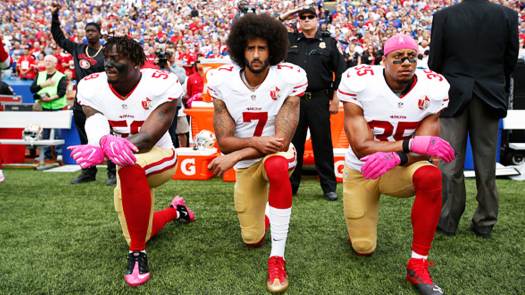
The reference that PETA makes to Colin Kaepernick is significant because of the divide his protest caused. His choosing to kneel during the playing of the national anthem sparked a national outrage amongst many people. Some believed his kneeling was a disrespect to the anthem and country, and others thought it to be disrespectful to the military and veterans. Kaepernick, however, simply was intending to peacefully protest and bring attention to police brutality and racial injustice after multiple national incidents. Kaepernick protested so that every person could be treated equally, and that’s the idea that PETA is drawing upon for their ad. They want to inspire people to come together as one to help protect animals in need.
On PETA’s website, they go in depth about their ad and some more of the significance behind it.
This ad was banned from the Super Bowl because of its reference to Kaepernick. He is a sore spot with the NFL, as his protest enraged fans and caused the NFL to lose viewers. Overall, I think PETA’s add sends a message of unity, and has a unique way of showing it. In the lecture video for 2.4, we talked about synthesis. Synthesis is taking what you know and learned, and created a new message with it. PETA took Colin Kaepernick’s protest and used it to create their new advertisement about unity. Their key phrase in the advertisement is speciesism, which they define on their website as “a supremacist worldview. It allows humans to disrespect other living, feeling beings and to treat their interests as unimportant.” Basically, it is a form of discrimination from humans to animals, and PETA’s goal with their ad is to promote this message.
 Carson Hilliard's Blog